
Thought Pillars
We are living in a time of paradoxes.
Some of the hardest problems I have to solve as a scaleup advisor are the ones where the obvious path forward made the problem worse.
That’s what a paradox does. It tricks you into believing you should follow one path when that’s the exact path that will block your growth.
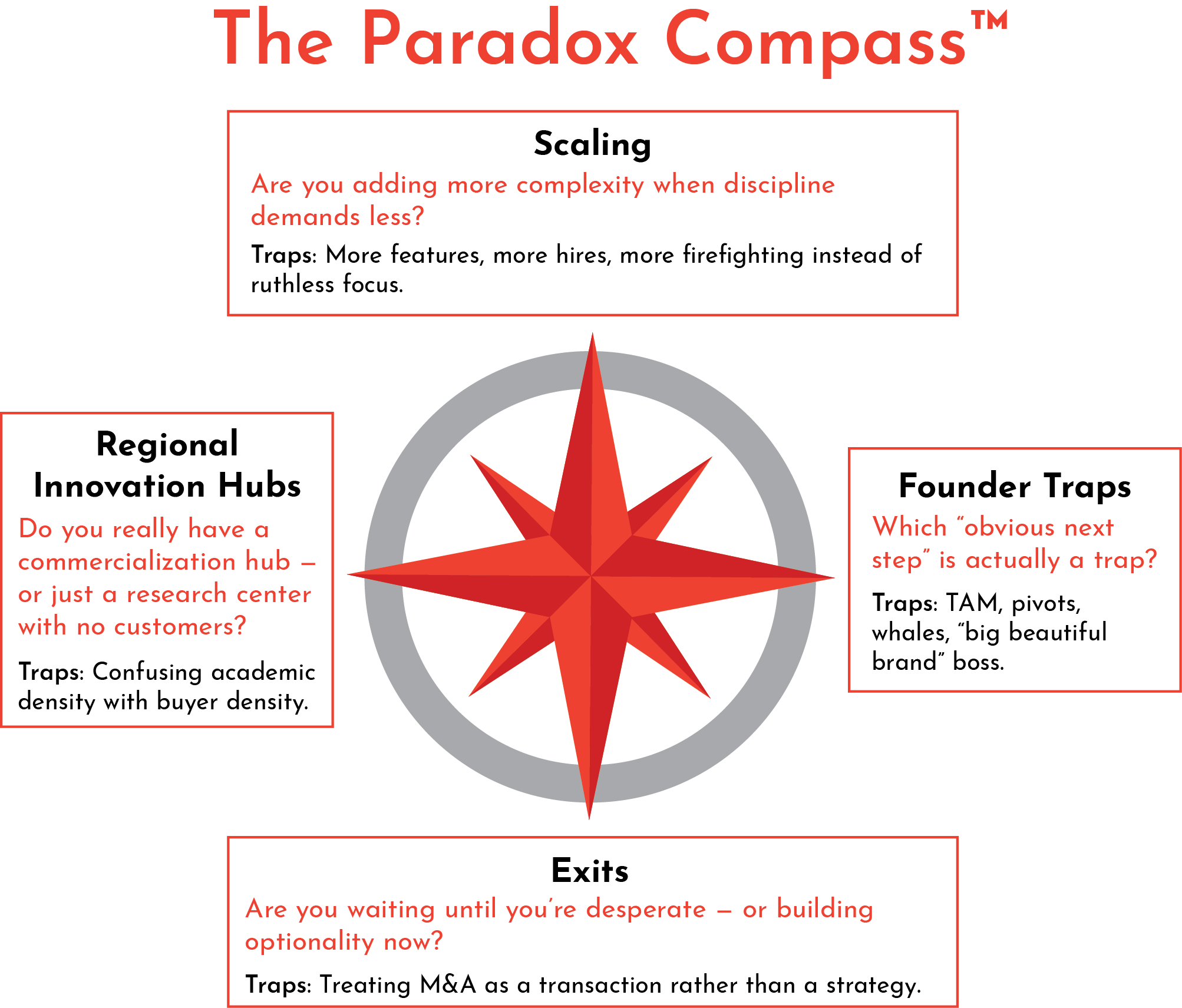
Scaling: From Firefighting to Discipline
Getting to traction isn’t the same as scaling. Scaling is when firefighting and hustle stop working, and discipline takes over.
The paradox is that companies usually think they need more — more features, more hires, more money. In reality, scaling comes from:
Focus – Doing fewer things better. A 10x goal that aligns everyone beats 100 incremental projects.
Leadership evolution – Founders stop doing everything themselves and build an executive team that can lead across functions.
Systems over heroics – You can’t scale if every success depends on one person pulling an all-nighter.
Most founders fail here because they can’t let go of what made them successful at launch. Scaling is about building something that can succeed without you.
Founder Traps: When the Obvious Path Blocks Startup Growth
Some of the hardest problems I solve as a scaleup advisor are the ones where the obvious path forward makes the problem worse. That’s what a paradox does. It tricks you into believing you should follow one path when that’s the exact path that will block your growth.
The big ones I’ve had to wrestle with:
The TAM Paradox – Big markets don’t mean real opportunities. The biggest companies often start narrow.
The Big Beautiful Brand Boss – Title and polish don’t build companies. Startups need builders, not managers.
The Pivot Paradox – Sometimes the business you built can’t solve the problem you now face. The team that ran your machine may not be the team that can lead a pivot.
The Whale Paradox – The enterprise customer can validate your business—or drag you under.
These are the traps founders hit again and again. My job is to help them see them coming.
Exits: Playing the Long Game, Start Before You Need to
Exits don’t happen because you suddenly decide you’re ready. They’re rogue waves—they come on someone else’s timeline.
Founders make two big mistakes: waiting until they’re desperate, and thinking M&A is a transaction instead of a strategy. The companies that succeed at exit build optionality all along. That means:
Preparation — Positioning early for potential acquirers.
Analysis — Understanding what gaps you fill for them (talent, product, revenue, opportunity, or profitability).
Flexibility – Keeping access open to multiple outcomes, so you negotiate from strength, not weakness.
If you treat exit as a last-minute scramble, you’ll get crushed by the wave. If you build for it all along, you’ll have real choices.
Regional Innovation Hubs: What It Really Takes to Build Them
Everyone likes to talk about “startup ecosystems.” But most never do make it past a research institute and a startup accelerator. The real test is whether the region has been set up to commercialize and scale innovative startups.
There are four elements that have to line up to create a successful regional innovation hub:
Density of people – A critical mass of the right talent who exchange, build and have a risk taking profile.
Anchor customers – Large buyers who create steady demand and validate early solutions.
A culture of risk – Where failure doesn’t end careers, it recycles talent and ideas into the next venture.
A public spine – Universities, infrastructure, and policy that provide the baseline no startup can fund on its own.
Regions that have these four create companies that scale.