
Scaleups, Innovation Hubs & An Economy for All
I'm Widening the Lens
For the past several years, this newsletter has lived close to the ground — inside the operational mechanics of scaling a company where transformation actually happens. That focus came from where I’ve been standing for a few decades – holding executive roles across operations, strategy, corporate development, and corporate administration.
My most recent mandate at Automation & Factory Solutions is complete. We recently successfully sold the company, and I've handed off the operational threads I was carrying. This transition is giving me something I haven't had in a while: room to look up from the day-to-day and ask a bigger question.
Not just how does a company scale. But how does an economy scale — and what has to be true, at every level, for that scaling to include more than a few?
So I'm expanding what I write about, with a focus on 3 concentric circles.
The first circle is the one you already know — topics for operators and leaders inside companies ready to scale. The frameworks I've built here, like From Firefighting to Function, came out of real transformations: understanding that analytics and AI implementations are pointless without clean underlying data, redesigning operations so that critical knowledge doesn’t live only in one person's head, pushing through change management when resistance peaks, and thinking long and short, not just fast and slow. This circle is my core strength and also the foundation the other two are built on.
The second circle expands to a regional view — how a geographic region builds the conditions for scaled innovation to happen at all. Capital, talent, mentorship, and the informal infrastructure and networks that connect a founder to the people who can actually help them. This is less visible than a company's P&L, but it's just as decisive to a local company’s success. A great founder in the wrong ecosystem struggles for reasons that have nothing to do with their product.
The third circle is the broadest — the legal and policy scaffolding underneath both of the first two. Tax structure, IP protection, government funding, campaign finance, antitrust, labor policy. The rules that decide whether an innovation economy is built for broad participation or narrows toward whoever already has access. This is the circle most people in tech avoid writing about. I don't think we can afford to.
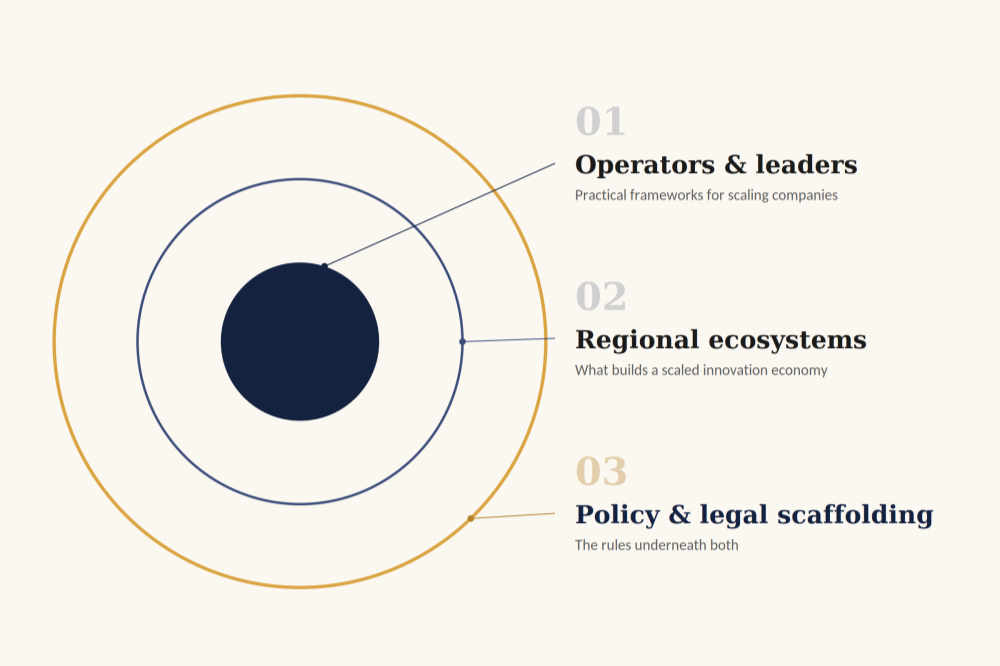
Three circles. One Question.
What builds durable, broadly shared growth?
I've built and executed corporate and operational strategy at many different stages of company life — from Cadence Design Systems as a public NASDAQ company, through UserTesting's path to IPO and its $1.3B acquisition by Thoma Bravo, to AFS's carve out acquisition.
I’ve seen first hand what works and what doesn’t in ecosystem building through my experience as an advisor at UC Berkeley SkyDeck and the Western Entrepreneurship Institute. I understand professional community building having built a few myself, including ChIPs Network and HiPower . Regional ecosystems only work when they help widen access to the networks that make scaling possible.
I came to business through law. My early career was in technology transactions and corporate law work. Most of this was focused on the legal side of building companies, but sometimes, we had to engage in government policy to break down barriers to economic growth. It’s interesting to consider similar issues outside of one company’s concerns. And it's exactly the kind of scaffolding work I mean when I say this third circle matters.
These three circles aren't separate interests. They're the same question — what does it take to build durable, broadly shared growth — asked at three different altitudes.
Thank you for reading this far, and for being part of this community as it's grown.
I hope what comes next is as informative and actionable as what came before, even as the lens widens.